
Background of the Study: Meaning, Purpose, and Placement in a Research Paper
What background of the study means
- Background of the study is the part of a research paper that introduces the reader to the topic by explaining the broader context and the situation that makes the study necessary.
- Background of the study answers the question of what is happening in the field and why the topic deserves research attention.
- Background of the study works like a bridge between the general topic and the specific research problem, so the study does not feel disconnected.
- Background of the study often includes a short, focused mention of what research already says, but it is not meant to be a full literature review.
- Background of the study usually starts broad and becomes more specific, guiding the reader toward the study focus.
- Background of the study can also define key terms and concepts, especially when the audience includes non-specialists.
The purpose of background of the study in a research paper
- Background of the study helps readers understand why the research matters before they reach the problem statement and research questions.
- Background of the study builds credibility by showing you understand the field, the trends, and the issues that shape the topic.
- Background of the study shows what is already known and points to what is still unclear, which prepares the reader to accept the research gap.
- Background of the study supports the logic of the study by linking context to the problem, then to the purpose and objectives.
- Background of the study can highlight contradictions in the literature, limitations in existing evidence, and practical challenges that justify new research.
- Background of the study makes the later parts of the paper easier to follow, because the reader already understands the setting and need.
Where to place background of the study in the paper
- Background of the study is placed early in the paper because it prepares the reader to understand the research problem and the direction of the study.
- In many research papers, background of the study appears inside the introduction, usually after the opening paragraphs and before the problem statement.
- In longer papers, proposals, dissertations, or theses, background of the study may appear as a standalone section or subheading in Chapter 1.
- Background of the study is typically positioned before the purpose statement and the research questions or hypotheses, because those depend on the context established earlier.
- A common structure is: introduction, background of the study, problem statement, purpose of the study, research questions or hypotheses, then the literature review and methodology.
- When deciding placement, a practical rule is that anything the reader must know to understand the problem belongs in the background of the study, while deeper and more detailed study-by-study discussion belongs in the literature review.
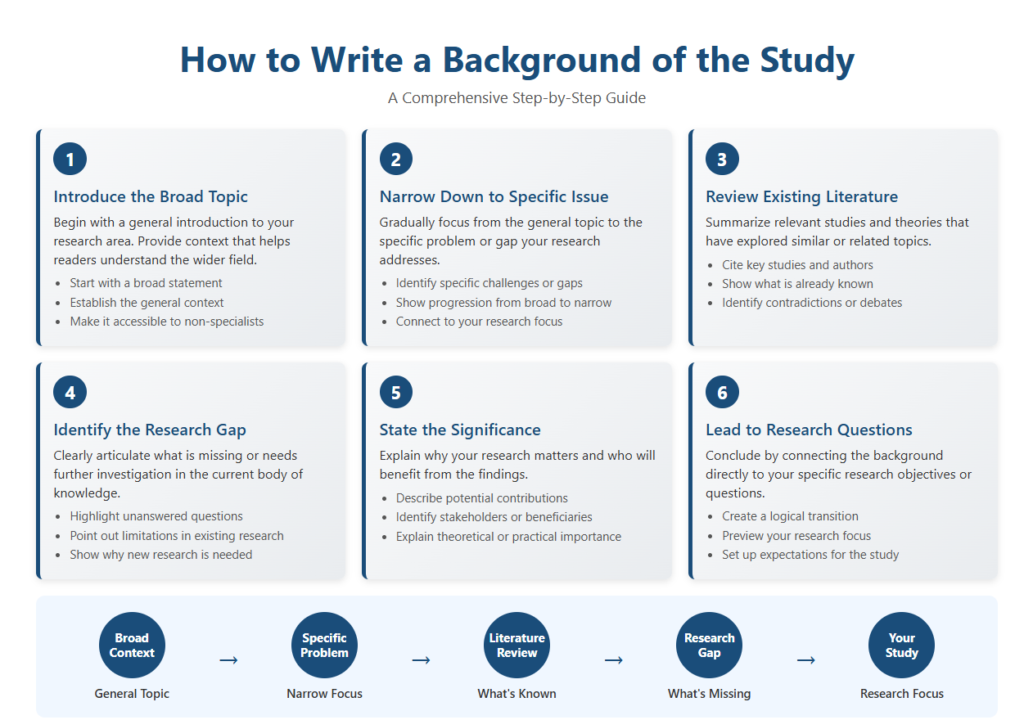
Background of the Study: Step-by-Step Writing Framework (6 Steps)
Step 1: Introduce the Broad Topic
- The first goal of the background of the study is to introduce the overall research area clearly.
- This opening part of the background of the study should make readers feel oriented, not overwhelmed.
- A good background of the study begins by explaining the broader field where the research sits.
- In the background of the study, you should create a general foundation before discussing any specific problem.
Start with a broad statement
- Open the background of the study with a simple, broad statement about the field.
- Choose a statement that is widely understandable and not overly technical.
- Make the broad statement in the background of the study relevant to real life, not just academic interest.
- Examples of broad openers for the background of the study:
- “Access to quality education remains a key driver of social and economic development.”
- “Digital technologies are reshaping how organizations communicate, manage resources, and deliver services.”
- “Health systems worldwide continue to face challenges related to workforce capacity, patient safety, and equitable care.”
Establish the general context
- Provide background context in the background of the study such as:
- Historical changes over time
- Current trends and emerging challenges
- Global or national relevance
- Population-level impact
- Use the background of the study to define the setting of your research topic.
- Ensure your background of the study answers: What is happening in this field right now?
Make it accessible to non-specialists
- A strong background of the study should be readable to a person outside your field.
- Use simple language and define key terms early in the background of the study.
- Avoid heavy jargon, or if you must use it, explain it briefly within the background of the study.
- Focus on clarity, because the background of the study is meant to guide readers into the research, not test them.
Step 2: Narrow Down to Specific Issue
- After you introduce the broad area, the background of the study should gradually focus on your specific issue.
- The purpose of this part of the background of the study is to move from general context to a more defined research concern.
- Your background of the study should feel like a funnel: wide at the start, narrow at the end.
- If your background of the study jumps too quickly, it will feel disconnected or confusing.
Identify specific challenges or gaps
- In the background of the study, identify the specific problem that exists in the real world or research world.
- Examples of challenges you can highlight in a background of the study:
- Persistent inequalities, access barriers, and disparities
- Underperformance, inefficiencies, or quality gaps
- Risks, threats, or vulnerabilities (for example, cybersecurity risks)
- Policy implementation challenges and resource constraints
- Training gaps, knowledge gaps, or skills gaps
- The background of the study should show why the situation is important enough to investigate.
Show progression from broad to narrow
- Use linking ideas in the background of the study that show movement from general to specific:
- “Despite these improvements…”
- “However, evidence suggests…”
- “In practice, organizations still struggle with…”
- “At the local level…”
- Your background of the study should not feel like separate points; it should feel like one developing storyline.
Connect to your research focus
- Near the end of this step, the background of the study should align tightly with your chosen research focus.
- Your background of the study should answer:
- What specific setting, group, location, or organization is affected?
- What specific issue is your research targeting?
- What is the practical consequence if the issue remains unresolved?
- This part of the background of the study makes your research direction clear without fully stating your research questions yet.
Need expert dissertation writing support? Get started today.
Order Dissertation Writing ServicesStep 3: Review Existing Literature
- This stage of the background of the study briefly summarizes what research already says.
- The background of the study literature section is not a full literature review.
- Instead, the background of the study includes enough literature to show:
- You understand prior work
- The topic has been studied
- There is a credible basis for the study
- In the background of the study, you should focus on the most relevant studies and ideas.
Cite key studies and authors
- In a formal academic background of the study, you would cite major authors and landmark studies.
- In this blog context, focus on what you would include:
- Seminal theories or widely accepted frameworks
- High-impact empirical studies
- Recent peer-reviewed research in the last five to ten years
- The background of the study should not list random studies; every study mentioned should serve a purpose.
Show what is already known
- Your background of the study should summarize key findings already established, such as:
- Patterns, relationships, and trends found in previous studies
- Evidence about what works and what does not work
- Predictors, risk factors, or outcomes already identified
- Common explanations and conclusions across multiple studies
- The background of the study should show that your research is grounded in what is already known.
Identify contradictions or debates
- Many strong research projects begin because literature is not consistent.
- In the background of the study, highlight:
- Conflicting findings across studies
- Differences in methods, settings, or populations
- Debates about definitions, frameworks, or measures
- Areas where evidence is outdated or inconclusive
- This strengthens the background of the study because it shows real intellectual need, not only personal interest.
Step 4: Identify the Research Gap
- The most important job of the background of the study is to justify the need for your research.
- That justification comes from the research gap you identify in the background of the study.
- A research gap is what is missing, unclear, or insufficient in current knowledge.
- Your background of the study should make the gap visible and convincing.
Highlight unanswered questions
- The background of the study should point to questions that remain unanswered, such as:
- What causes the problem in specific contexts?
- Why do interventions work in one setting but not another?
- How do different groups experience the same issue differently?
- What outcomes have not been measured or tested?
- Make sure your background of the study gap is specific, not vague.
Point out limitations in existing research
- A strong background of the study explains limitations such as:
- Small sample sizes or weak generalizability
- Overreliance on one region, population, or sector
- Missing perspectives (for example, ignoring users or frontline workers)
- Inconsistent measurement tools
- Lack of longitudinal evidence
- Lack of qualitative detail, even when quantitative trends are known
- These limitations should lead naturally to your study in the background of the study.
Show why new research is needed
- The background of the study should clearly state why your study is needed now.
- Reasons can include:
- The problem is growing or changing
- Existing research no longer fits new realities
- Policies or technologies have changed
- Stakeholders need local or context-specific evidence
- Existing solutions are not effective enough
- Your background of the study should make the study feel necessary, not optional.
Step 5: State the Significance
- This part of the background of the study answers: Why does this research matter?
- A good background of the study explains both practical significance and theoretical significance.
- In the background of the study, significance must be linked to the gap you identified.
- If you state significance without linking it to the gap, the background of the study feels weak.
Describe potential contributions
- In the background of the study, explain what your study could add:
- New evidence, new data, or new insights
- A better model, framework, or measurement approach
- Improved understanding of causes, patterns, or experiences
- Evidence for decision-making and planning
- A good background of the study makes these contributions realistic, not exaggerated.
Identify stakeholders or beneficiaries
- The background of the study should name who benefits:
- Policymakers
- Practitioners (teachers, nurses, managers, social workers)
- Organizations and institutions
- Community members and service users
- Researchers and academic communities
- Naming stakeholders makes the background of the study more concrete and persuasive.
Explain theoretical or practical importance
- Practical importance in the background of the study can include:
- Better service delivery
- Increased safety and quality
- Reduced cost or inefficiency
- Improved equity and access
- Stronger policy or program implementation
- Theoretical importance in the background of the study can include:
- Testing a theory in a new context
- Filling a conceptual gap
- Extending a framework to new variables or settings
- A strong background of the study often includes both.
Step 6: Lead to Research Questions
- The final part of the background of the study prepares readers for your research questions.
- In a strong background of the study, the research questions feel like the natural next step.
- This step is where the background of the study becomes tightly connected to your objectives.
Create a logical transition
- The transition in the background of the study should connect:
- Context to literature to gap to significance to research focus
- Common transition phrases for the background of the study:
- “Given these gaps in the literature…”
- “Therefore, this study seeks to…”
- “In response to these limitations…”
- The transition is critical because it makes the background of the study feel complete and purposeful.
Preview your research focus
- The background of the study should briefly preview:
- The target population or participants
- The setting or location
- The key variables or themes
- The type of study (qualitative, quantitative, mixed methods) if relevant
- This preview should be short but specific, because the background of the study is not the methodology section.
Set up expectations for the study
- The background of the study should end with clear expectations about what the study will address.
- It can preview:
- Research objectives
- Research questions
- The central focus of investigation
- This signals to the reader that the background of the study has done its job and the main study is about to begin.